Showing posts with label food. Show all posts

Thursday, April 26, 2007

The price of a cup of coffee


What does a cup of coffee cost? Maybe around $1.19 at a convenience store... and even less than that when we brew it at home. Coffee is cheap, and pretty much any of us can drink it any time we like. But, as with most agricultural production, coffee production entails many more costs than consumers in industrialized countries are compelled to consider when we lay out our cash. What is the real price for a cup of coffee? This is what I have been trying to figure out for quite some time now. Here is what I know.

Coffee has traditionally been grown, at least in the Western Hempsphere, in tropical forests under the shade of a diverse understory. These areas by nature are centers of extreme biodiversity, and they provide critical wintering habitat to many species of North American migratory birds. These forests, in addition, are powerhouses where carbon dioxide is removed from the atmosphere and converted back into oxygen--a process our planet depends on to keep levels of greenhouse gases in our atmosphere down to a safe level.

As the demand for coffee has grown, coffee producers have turned to new farming methods to achieve a more large-scale crop. More coffee can be produced in the open sun than beneath the understory cover of these tropical forests, so forests have been clearcut to make way for agricultural land that can be cultivated to meet the growing demand for coffee. Farming this way increases the need for fertilizers to artificially enhance the soil and for pesticides to protect the crop from new threats. The implications are severe: Crucial habitat for exotic and migratory birds, as well as other species, has been lost, leading to rapid extinction--very often killing off species that humans had not yet even discovered. The loss of the flora which naturally enriches the soil with minerals has led to the dumping of chemicals all over the land. Basically, these lands that were once forests with rich and healthy soil are now barren, dry, and on life support. These chemical fertilizers cannot keep the land arable forever; one day that land will become useless, unable to support any green life. The chemicals from the fertilizers and the pesticides have to go somewhere--so they eventually end up poisoning the water supply. Not to mention that every lost acre of forest is a loss for the atmosphere; carbon dioxide builds up, as fewer trees are around to convert it.

The human labor cost is dire as well. When people of industrialized nations demand lower prices on coffee, the true cost of producing that coffee does not change. Since we, the consumers, are no longer bearing that cost, then we know that someone else must be--the laborers on these large-scale coffee farms. They work long hours in the hot tropics, receiving an inequitable wage for their labor. They have no choice--somehow they must earn a living for themselves and their families. We in America thought that slavery had been abolished long ago. Yet we consume products like coffee, whose artificially deflated prices make it easily accessible in large quantities to everyone (coffee was considered a luxury not so long ago), and we do so without any regard for the labor conditions under which it was produced for us. That sounds a lot like slavery to me.

When consumers make ethically sound decisions in their purchases, that action speaks very loudly to those who operate in the production of commodities. If we choose coffee that is organic, fair trade certified, and shade grown, we are supporting a return to environmentally sound agricultural practices as well as a fair wage to those whose livelihoods are linked to our coffee consumption. Sure, you pay a higher price for coffee when you make these decisions--but the price you pay is much closer to the "real" cost of coffee than the artificially deflated prices that we see on most mainstream brands. Just as meat would be far more expensive to consumers if it were not subsidized by the government (another reason to go vegan), other luxury items like coffee, and even chocolate and cane sugar, wear attractive price tags today that do not reflect their true cost.


I have made a switch to buying only organic coffee that is fair trade certified. It can be difficult to find coffee that is explicitly guaranteed to be organic, fair trade certified, and shade grown. What is the interplay between these three elements? I have been doing some research to find out, and I came across this excellent site called Coffee and Conservation. Take a look at this link for some practical guidelines on how to ensure that your coffee is truly produced in an ethically sound and sustainable manner, from an environmental and a social viewpoint. I encourage you to explore this site some, as it is packed with valuable information about what is sustainable and what is not, and what we as consumers and concerned citizens of this planet can do about it. The cost of producing a cup of coffee may be far removed from us, but we will all inevitably bear the cost of our choices in the end.

Friday, April 20, 2007

It's easy eating green

Many people who are disgusted by the world climate crisis do not realize that one of the top contributors to greenhouse gas emissions is connected with their diet. Eating vegan or vegetarian does more to reduce emissions than does driving a fuel-efficient, hybrid car. Unbelievable? Check out the following articles:

Vegetarian is the New Prius

Kathy Freston, in this article dated 18 January 2007, cites the findings of a recent report released by the UN, which points to livestock production as "one of the top two or three most significant contributors to the most serious environmental problems, at every scale from local to global." She also reports on the results of research conducted at the University of Chicago, in the following statement:

[Researchers] noted that feeding animals for meat, dairy, and egg production requires growing some ten times as much crops as we'd need if we just ate pasta primavera, faux chicken nuggets, and other plant foods. On top of that, we have to transport the animals to slaughterhouses, slaughter them, refrigerate their carcasses, and distribute their flesh all across the country. Producing a calorie of meat protein means burning more than ten times as much fossil fuels--and spewing more than ten times as much heat-trapping carbon dioxide--as does a calorie of plant protein. The researchers found that, when it's all added up, the average American does more to reduce global warming emissions by going vegetarian than by switching to a Prius.

You can read more about the UN report in the following article on the website of the Food and Agricultural Organization of the United Nations:

Livestock a Major Threat to Environment

How about this article by investigative journalist Jeffrey St. Clair, which points to cattle production as a top threat to the health of the Western U.S.'s public lands?

Till the Cows Come Home

The following article, written by Dan Brook, points out that the two gases that comprise 90 percent of U.S. greenhouse gas emissions are carbon dioxide and methane--both of which are emitted by large-scale cattle farms at the rate of millions of tons each year. The article also addresses livestock cultivation's role in the destruction of the world's rainforests, which are absolutely crucial to the removal of harmful carbon dioxide from the atmosphere.

Another Inconvenient Truth: Meat is a Global Warming Issue

There is so much evidence out there that it is difficult to deny, once you begin studying the issue, that the current state of the planet is inextricably linked to the human population's unsustainable diet. Consider the following quotation from the Kathy Freston article:

The United States alone slaughters more than 10 billion land animals every year, all to sustain a meat-ravenous culture that can barely conceive of a time not long ago when "a chicken in every pot" was considered a luxury. Land animals raised for food make up a staggering 20% of the entire land animal biomass of the earth. We are eating our planet to death.

And yet, it is so easy to eat a vegan or vegetarian diet. Sites like Vegan Outreach and GoVeg.com are designed to show how simple it can be to eat a healthy, delicious plant-based diet, and how such a lifestyle benefits the quality of life on this planet for so many creatures in so many different ways. There are vegan and vegetarian cooking sites all over the Web--you can even check out my vegan food blog and from there, explore the many vegan cooking resources that it links to.

I could not consider myself an environmentalist and justify eating an animal products-based diet--the global harm caused by animal agriculture is just too evident. Many people would feel the same way, I believe, if only they knew the facts.

This Sunday, 22 April, is Earth Day--and I believe it is one of the most critical Earth Day celebrations in the history of our country, as more people are aware this year than ever before of the dire climate crisis which our world faces. Please, do not ignore the facts surrounding animal agriculture. Take a look at these articles, and if you are still not satisfied, do some more research. If we truly hope to reverse the destruction of our global environment, one of the crucial steps we must take is turning away from animal-based diets and toward a safer, healthier, greener alternative.

Wednesday, July 26, 2006

Something else I've been meaning to post

Several months ago, I made this really, really great vegan red beans and rice recipe. One of my accounting professors is a Louisiana man and loves to cook traditional cajun food. I asked him for some advice on making authentic red beans and rice. Of course, I didn't use the andouille or the ham hocks like he suggested; I substituted some other flavors and it came out so well! I wanted to put the recipe out there, in case anyone else is interested.

1 package of red beans, cleaned and soaked overnight (I had a package of light red kidney beans that I wanted to use up, but I would probably use some other variety of red bean next time)
1 tablespoon "chicken" boullion (check the ingredients)
2 tablespoons cajun/creole seasoning blend (if you purchase a blend, be aware that it has a great deal of salt in it, and adjust the salt in your beans to account for this)
As many dashes of Louisiana Hot Sauce that your palate can handle
Salt
2 bay leaves
2 cloves garlic, pressed or crushed and finely minced
1 sweet onion, finely chopped
1 green bell pepper, finely chopped
6 stalks celery, finely chopped

Bring all of these things to a boil in a large pot with the lid on, in enough water to cover the beans plus about a half an inch. Let simmer for an hour or so, until the beans are very tender and all the flavors have married. The onion, green pepper, and celery will almost become invisible if you have chopped them finely enough, but they will still pack a lot of flavor. Monitor the seasonings along and along--I ended up adding lots of hot sauce, since I like to breathe fire when I eat cajun food.

Once the beans are tender, scoop out about 1/2 to 1 cup of the beans and place in a bowl. Using a fork, mash the beans until they form a thick paste. When smooth and thick, stir the paste back into the pot. This step will give the finished product a saucy texture, and I think it helps bind the rice to the beans so that your meal is truly one dish, rather than red beans served over rice.

Speaking of rice, I used brown rice and cooked it using some of the same seasonings that I used in the beans so that the addition of the rice would not make the entire dish bland. The first time we ate it we served the bean mixture over the rice, but when I put it up for leftovers I just stirred the rice into the pot--it worked great both ways.

Long overdue, I know

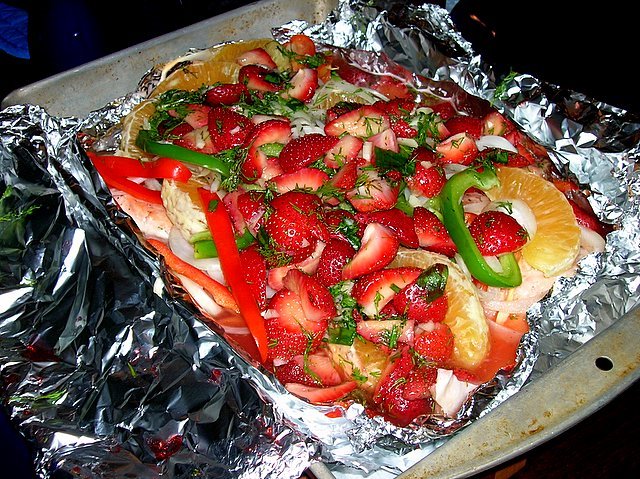
I promised this photo a long time ago. This is the salmon Bob and I made for our aunt and uncle. Yes, there is salmon in that picture, but it's buried underneath so many other wonderful things--strawberries, oranges, red and green peppers, honey, fresh baby dill... But believe it or not, all those different flavors did not steal the show in this meal. The salmon tasted very much like salmon, with just a hint of sweetness and zest. It was very tender and baked to just the perfect degree of doneness.

We got the recipe from The Food Network, one of Paula Deen's recipes. I don't ever cook Paula Deen's creamy, rich, thick southern food, but this was a recipe that she actually borrowed from a friend of hers. Light and sweet and healthy, this and some wild rice and a small green salad made a wonderful meal. All the ingredients were fresh, too--straight from the Dekalb Farmer's Market. Posted by Picasa

Sunday, July 02, 2006

A favorite that never fails...

So this weekend my husband came to Atlanta to visit me, and in our limited and shared kitchen space we didn't feel like making an elaborate mess to clean up. So today I made a lunch of something that always satisfies me--black beans. This time I took a Tex-Mex approach and made a spicy, delicious soup. A very economical meal, healthy and nutritious, and VEGAN! Bob and I classify ourselves as vegan-curious these days, and perhaps a permanent switch is coming soon.

2 cups dried black beans
1/2 minced red onion
3 cloves garlic, crushed
2 stalks minced celery
1/2 minced green bell pepper
1/2 to 1 jalapeƱo, minced (I had to go easy, since spiciness is not something my 10-year-old cousin's palate will tolerate)
2 tsp. dried oregano
1 & 1/2 cups cooked corn
1 & 1/2 cups diced tomatoes
1/2 cup salsa (I used a cilantro-lime salsa)
Salt, to taste
Cayenne pepper, to taste

After soaking the beans overnight and rinsing them, I put them in a pot to boil with water to cover plus about 2 inches over the top. I added the onion, garlic, celery, peppers, oregano, salt, and cayenne and let it boil gently with the lid on for about an hour, until the beans were tender. I then added the corn, tomatoes, and salsa, and I let it simmer for another half hour, again with the lid on, until all the flavors were married. This was not as spicy as I would have liked it personally, but it pleased the palates of the family so I was satisfied with it.

The salmon we made on Tuesday night came out so well--it was beautiful. I took pictures but tonight it is too late to upload them. I will do that soon. It was the best salmon I have probably ever had, rivaled perhaps only by seared rare salmon atop a mixed greens salad. This salmon was topped with so many different fruits and vegetables that I cannot even think of them all here, then sealed in foil and baked. It was tender and juicy and full of aroma and flavor... Bob said that he could go vegan right then and never miss fish, because his final fish experience would have been so memorable. We got our fish and produce at the Dekalb Farmer's Market, which is enormous and absolutely wonderful. A pint of organic strawberries for $2??? Incredible.

I found out on Friday that I get to run in the Peachtree Road Race on 4 July--the world's largest 10K race. Of course I won't be racing. I'll be amazed if I manage to run the whole thing, with the shape I'm in lately. But I'm excited just to be a part of it, just to get to challenge myself, just to experience something that 55,000 people a year get to experience. I'll be on the train at 5:30 am on Tuesday morning, to get to the race which starts at 7:30. Perhaps at that time of morning the heat won't be absolutely unbearable. I imagine myself taking a nice long nap before lunch.

Here's a new challenge for myself: I am striving to give up soft drinks. Completely. I am so addicted to Diet Coke, it's unbelievable. It's got to stop. I know it will be difficult, especially with the free sodas at the office that come in so handy during that time of day between lunch and 5:30 when it's so difficult to focus sometimes. But I've got to stop dumping that nasty stuff into my body. Maybe if I just remind myself that I'm poisoning my body and suppressing my respiratory system... Then perhaps it will seem worth it, at 3:00 in the afternoon, to just have another glass of water. Hmm, maybe I need to find a more natural solution for a mid-afternoon energy boost. Any ideas?

My last couple of posts were born of an intense creative streak that hit me a few nights ago. The poem was actually written a month or so ago, during my training week in North Carolina. I was napping out on the golf course before dinner, and every time I looked up I noticed the weeping willow to my left, its limbs trembling even in the near-still air. Suddenly hit with the urge to write, and having nothing on me except my purse, in desperation I canceled a check from my checkbook and penned that poem on the back. This past Wednesday, I finally pulled the check out and revised the verses. The other piece I posted was inspired by a game I recently played (Bob knew what game the moment he read the piece). I am enthralled by characters who are complex and emotional and not much different than myself, really. Those are the types of characters I strive to write. The story that Bob and I are writing is full of characters, some very profound and interesting, others largely one-sided and in desperate need of fleshing out. My favorite part of writing is creating the characters, learning their backgrounds. Yes, learning--for the characters are the ones who tell me about themselves, and I simply make a record of what they have to say. There is so much more to each character than what the reader finds on the page. But even though the life story is not delved into, the reader should be able to detect the dimensions that make up the character. The reader should know, just by reading, that this character is alive and full of history.

It's getting so late, and I'm getting carried away. I do actually have to go to work in the morning. Therefore, I will have to cut this off now. But there is much, much more to say...

Saturday, April 29, 2006

Yummy yummy tofu (etc.)

Hah! I've learned so much about cooking tofu since becoming a vegetarian--it can be tricky stuff. Yesterday, I made some great tofu burrito filling--just crumbled extra-firm tofu, sauteed with tomato paste and spices. That was a very-fun project, and it has inspired me. I've been cooking all day today, mostly baking breads. My nature writing class went out to Big City Bread for lunch today, and the restaurant was very quaint and the food delicious. Grilled vegetable wrap, including eggplant, zucchini, portabellas, red peppers, spinach, feta, and tzatziki sauce. Yum! But the thing that really got to me at the restaurant today was the bread selection--never, except in a Parisian boulangerie have I seen more wonderful things. So I immediately came home and made whole wheat oatmeal bread. Later tonight, I made cherry-walnut banana bread from the Fatfree Vegan Blog, of which I am a frequenter. One thing I've always wanted to do is bring the taste of French bread to the U.S.--something that has never, that I am aware, been successfully done. French bread in the U.S. tastes not even remotely like the French bread in *gasp* France--even at such gourmet locations as Panera Bread and the Atlanta Bread Company. Somehow, I have to learn the secret to making authentic French bread. I start with handcrafting and kneading my own loaves--I know that makes a difference. One day, I will produce a baguette reminiscent of French breakfasts (and lunches, and dinners, and all in between...) and that may very well be the happiest day of my life.

It was so cool out today! The wind was very strong and chilling--I had to break out the long sleeves again. It was overcast most of the day but never rained, so on the whole today was my favorite kind of day. I remember watching storms approach when I was a kid--playing outside in the summertime, when suddenly you notice the sky growing dark and a wind coming in (usually from the east, sweeping off the ocean). Breathing in that pre-thunderstorm air is always envigorating, as if you are inhaling the very electricity and excitement of the storm itself. Those electrons brush your nerve endings and then... The storm is inside you, in all its grace and wonder. That's what today reminded me of--sitting at the table outside Big City Bread, the tiny white lights in the trees overhead were the brightest visible light source. The leaves rustled in the wind and let go of their branches, and suddenly we would look down to find our salads replenished with new leaves. I held my coffee mug tightly between the palms of my hands as the chill bumps formed up my arms to the opening of my three-quarter sleeves. But the rain never came. Not today.

It would have been a glorious day for a run, and indeed I planned on it, but this afternoon I came down with a headache/stomachache/sore throat. So I decided not to push my body too far. Perhaps this weather will linger into tomorrow.

Thursday, April 20, 2006

Vote with your fork?

When we go grocery shopping we have to make a choice--either we may buy the cheap, pesticide-laden produce that comes to us at the expense of farmland, the environment in general, and our own health--or we may vote against it. Buy organic. In other countries people pay very dear prices for their food, up to 1/3 of their annual incomes. In America? We spend less than 10% of our incomes on food, when we're the nation in all the world with the best chance to do something better.

I came across a blog entry today based on a speech, "The Cornification of America," delivered by a well-respected and talented nature writer/journalist named Michael Pollan. I read the blog, and was reminded of how strongly I feel about these things. I would say more, but that would be taking away from the power of his message. Read it for yourself.